Driver Project

Wastewater Surveillance

Wastewater and environmental surveillance (WES) is rapidly becoming a core pillar of public health, enabling early detection of circulating pathogens, tracking AMR determinants, and supporting prevalence and trend analysis. The PHA4GE Wastewater Surveillance Working Group maintains living, open guidance and resources to help programs design effective WES strategies, analyse sequencing and quantification data, and share results responsibly with the global community.

Problem Statement

The fast-moving WES field faces fragmented practices across study design, metadata capture, bioinformatics, and data sharing. Diverse data sources and systems hinder harmonisation and reuse; many labs lack practical tools to implement standards, perform QC, and exchange data with repositories. Without consensus guidance, interoperable specifications, and implementation support, programs struggle to generate comparable, actionable insights across settings.

Implementation Framework

 PHA4GE and partners are advancing a coordinated package of guidance, standards, tools, and training:

Guidance Portfolio
(living documents)

Wastewater Contextual Data Specification Package

Tooling & Interoperability

Quality, Maintenance & Community

Training & Capacity Building

Together, these efforts provide end-to-end, consensus-driven support for wastewater surveillance, enabling: interoperable data, reproducible analytics, and ethical, timely insights for public health action.

Resources

Face-to-face PHA4GE meetups are few and far between — so when they happen, they’re something special! In this episode, we sit down with Dr Joshua Levy, project scientist at Scripps Research (USA) and co-chair of the PHA4GE wastewater surveillance sub-working group, during his recent visit to South Africa.

Wastewater metagenomics is transforming how we monitor microbial communities, offering a powerful and cost-effective approach for pathogen surveillance, antimicrobial resistance (AMR) tracking, and environmental health insights. In Africa, high-throughput sequencing (HTS) of wastewater can serve as an early warning system for infectious disease outbreaks—especially in densely populated areas with limited sanitation—while also supporting discovery of emerging pathogens and novel microbial functions. This overview highlights both the major opportunities and the key challenges, including infrastructure limitations, bioinformatics capacity gaps, variable wastewater composition, and data governance considerations, and outlines the collaborations and investments needed to unlock equitable public health and economic benefits.

This publication presents the PHA4GE wastewater contextual data specification, an ISO-compatible, ontology-based standard developed with global partners to support interoperable wastewater genomic surveillance. Implemented through open-source tools and shared frameworks, the specification enables harmonised data integration and serves as a model for broader environmental and metagenomic surveillance standards.

PHA4GE’s Wastewater Surveillance Working Group provides open guidance and standards addressing surveillance strategies, data analysis, data sharing, and ethical considerations. These living resources support the application of state-of-the-art wastewater surveillance methods in public health practice.

PHA4GE has developed a wastewater contextual data specification to address challenges in harmonising, integrating, and reusing wastewater genomic surveillance data. The standard supports interoperable data exchange across surveillance systems and is extensible to broader environmental and One Health applications.

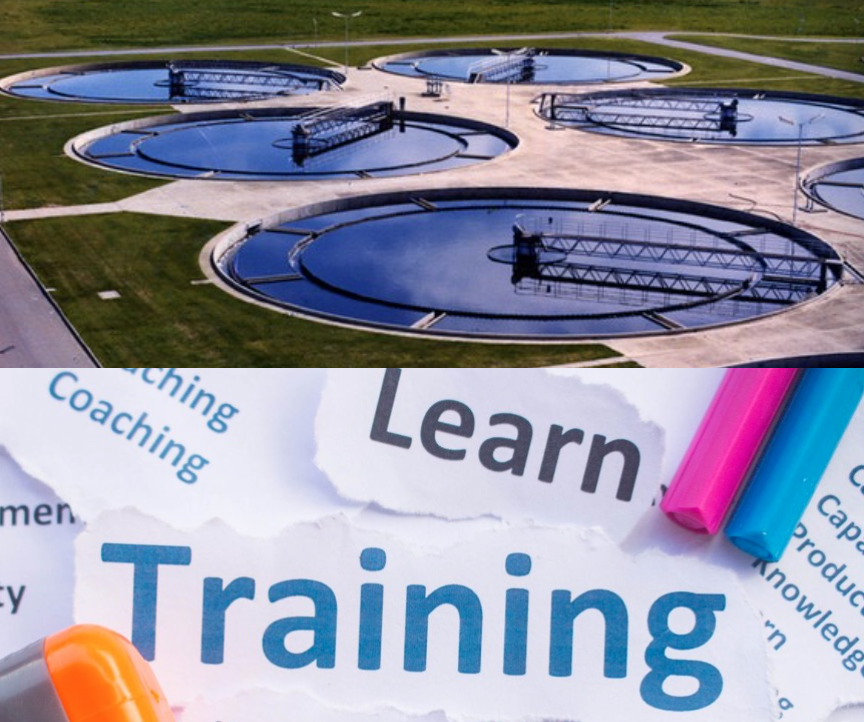
This training equips public health professionals with essential skills to monitor pathogens in wastewater and environmental samples, enhancing disease surveillance and outbreak response.

This publication describes the development of standardized contextual data quality-control (QC) tags by PHA4GE to support the responsible sharing and reuse of lower-quality or purpose-specific genomic datasets. Implemented using ontologies and adopted by public health networks such as FDA’s GenomeTrakr, the tags improve dataset discoverability, interpretation, and transparency across public repositories.

Related Links

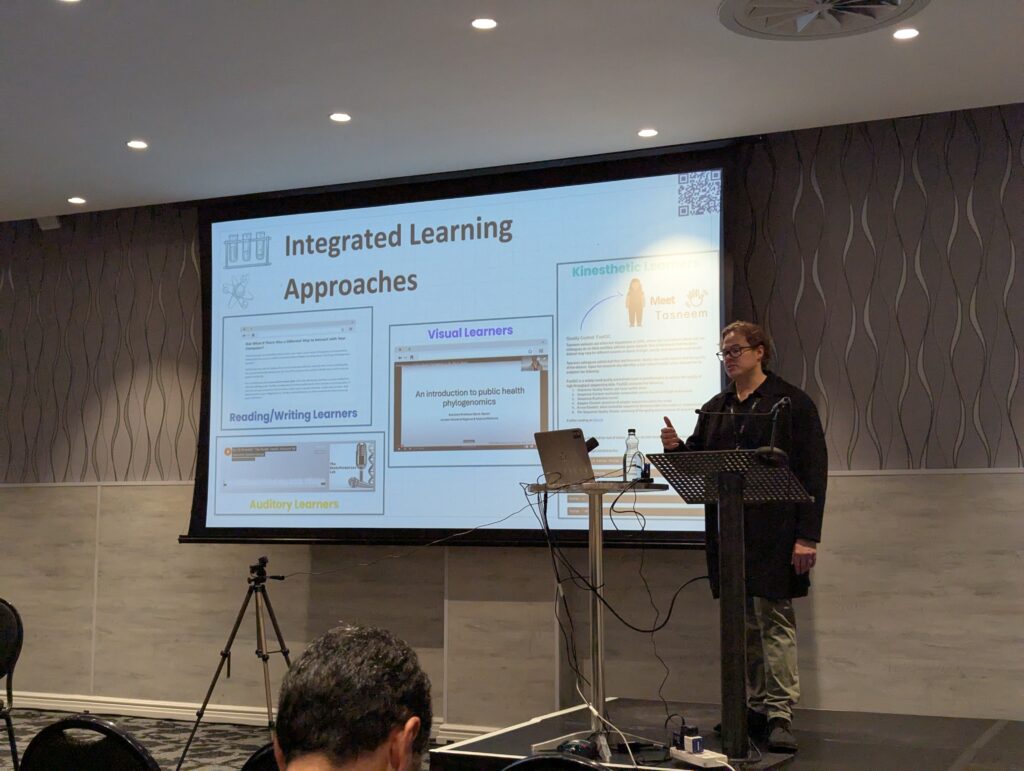
At the ISCB-Africa ASBCB Conference, Keaghan Brown presented PHA4GE’s new online course on wastewater surveillance, designed to integrate genomics, bioinformatics, and diverse learning styles. Developed with Farzaana Diedericks, the course uses an avatar-led format to teach real-time pathogen tracking through wastewater monitoring—enhancing public health capacity in Africa and globally.

Dr Joshua Levy, project scientist at Scripps Research in the US, visited the PHA4GE Secretariat hub at the University of the Western Cape (UWC) at the end of March.

GLOWACON Conference Attendees

Prof. Alan Christoffels joined the GLOWACON Regional Conference in Addis Ababa, supporting efforts to integrate wastewater monitoring into public health systems worldwide.

A look into how PHA4GE is creating a set of development guides, as well as a database of searchable attributes enabling the assembly of suites for specific use cases and ensuring that relevant terms are re-used, increasing interoperability across the data streams in public health

Wastewater surveillance is a crucial public health tool that involves monitoring the contents of wastewater to gain insights into community health. This method can detect the spread of infectious diseases, track drug use patterns, and assess the effectiveness of public health measures. By analyzing wastewater, health officials can identify outbreaks early, observe disease trends, and allocate resources more effectively, ultimately safeguarding public health.

Projects include a call for community input on Wastewater Contextual Data Specification and the development of a Data Standards Registry.