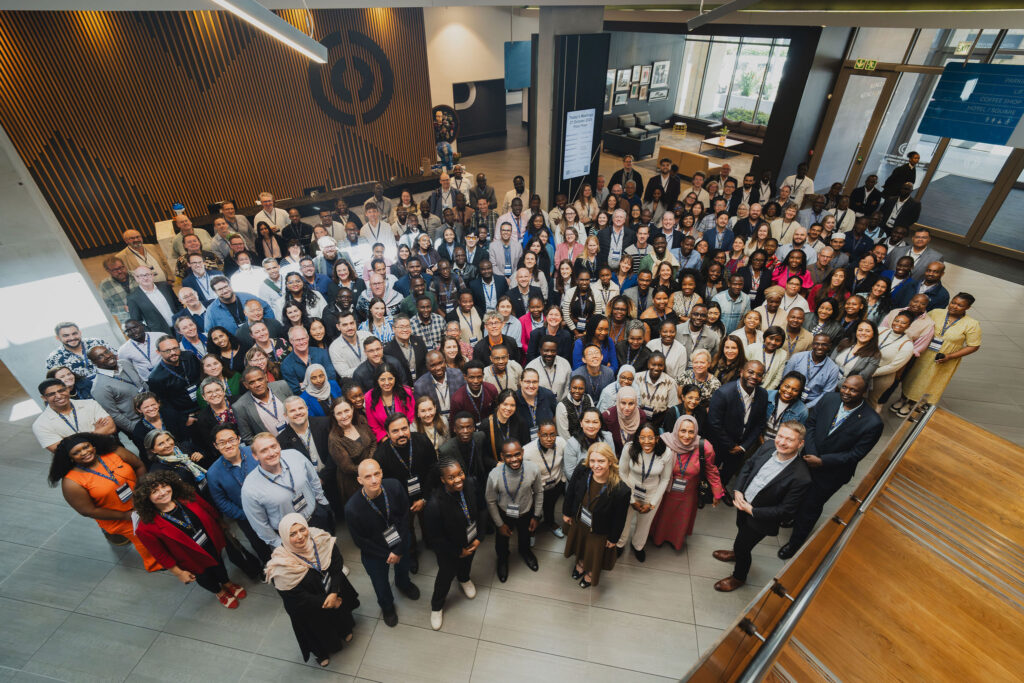
More than 270 scientists, policy-makers, funders and public health experts from around the world attended the third International Pathogen Surveillance Network (IPSN) Global Partners Forum in Cape Town, South Africa from 27 to 29 October 2025. The forum was held jointly with the second Public Health Alliance for Genomic Epidemiology (PHA4GE) biennial conference and was co-hosted by the WHO Hub for Pandemic and Epidemic Intelligence and WHO’s Regional Office for Africa.

Under the theme “Data for Action: Overcoming Challenges and Seizing Opportunities in Public Health Genomics”, attendees discussed how to operationalize genomics within surveillance systems, strengthen digital infrastructure, and shape a global data architecture rooted in collaborative surveillance and equity. The gathering underscored how pathogen genomic surveillance can strengthen global health preparedness and make the world safer for all.

Global Genomic Surveillance Strategy

The forum was also a key moment to advance WHO’s Global Genomic Surveillance Strategy for Pathogens with Pandemic and Epidemic Potential (2022–2032), a ten-year strategy to enhance genomic surveillance capacities globally. Participants reviewed the proposed three-year roadmap, developed during a hybrid workshop in June 2025 at the WHO Hub for Pandemic and Epidemic Intelligence, which brought together 14 organizations from 11 countries.

During the forum, partners agreed on the roadmap and ensured alignment with global priorities and regional capacities. They underscored three pillars for collective action: institutionalization of genomic surveillance through tools, policies, networks and frameworks, investment alignment and evidence-based advocacy and the need for coordinated data ecosystems aligned with national and regional priorities.

IPSN Catalytic Grant Fund

The IPSN Catalytic Grant Fund, administered by the United Nations Foundation, was launched in 2024 to support IPSN members in low- and middle-income settings, with the support of the Rockefeller Foundation, the Gates Foundation, Wellcome Trust, and the Institute of Philanthropy.

The fund supports IPSN members to pilot innovative ideas and create an evidence base for the rapid scale-up of pathogen genomic surveillance. A new round of funding is planned for early 2026.

Three projects from the first round were showcased during the event:

  • Lao PDR: Environmental genomic surveillance of avian influenza in live-bird markets;
  • Brazil: RT-MetA, an offline-capable, open-source framework for decentralized, real-time, untargeted pathogen genomic surveillance; and
  • Democratic Republic of the Congo: Genomic surveillance of drug-resistant pathogens by extending the Mini-Lab with a Nanopore MinION sequencer.

With strong low- and middle-income country (LMIC) representation, the event emphasized inclusive approaches and cross-sector collaboration to build resilient, data-driven public health systems. Outcomes from the forum will shape future strategies to turn genomic data into actionable insights for global health impact.

PHA4GE sub-grants (2021-2025)

The Public Health Alliance for Genomic Epidemiology (PHA4GE) is a global consortium established in 2019, to ensure a rapid global genomic-driven public health response to disease outbreaks. During the event, Consortium members presented their sub-grants, which are funded by the Gates Foundation to promote sustainable development and support public health in:

  • bioinformatics;
  • ethics and data sharing; and
  • wastewater environmental surveillance.

Since 2019, PHA4GE has built several genomic surveillance standards for anti-microbial resistance (AMR), SARS-CoV-2 and wastewater. Usability testing, interoperability and completeness of these standards for local and global public health applicability was necessitated through issuance of 29 sub-grants to public health labs and researchers. Eight sub-grants were also awarded to promote ethical data sharing of genomic data. Collectively, 24 LMICs were represented by the sub-grants.

PHA4GE continues to support training, standards’ development, and promoting best practices for genomic epidemiology.

Collaboration for Greater Impact – PHA4GE Conference & IPSN Global Partners Forum 2025 

We are delighted to announce that the International Pathogen Surveillance Network (IPSN) – a global network of pathogen genomic actors, brought together by the World Health Organisation (WHO) Hub for Pandemic and Epidemic Intelligence, is partnering with the Public Health Alliance for Genomic Epidemiology (PHA4GE) and WHO Regional Office for Africa for the upcoming PHA4GE Conference and IPSN Global Partners Forum (GPF) 2025.

The joint event will take place from 27 – 29 October 2025 at the Century City Conference Centre in Cape Town, South Africa, under the theme “Data for Action: Overcoming Challenges and Seizing Opportunities in Public Health Genomics.”

This collaboration highlights our shared vision of strengthening global capacity in genomic epidemiology, data sharing, and public health action. By joining forces, PHA4GE and IPSN are creating a platform for innovation, dialogue, and collaboration that will drive real-world impact globally.

Together, we are building momentum for a future where genomic data translates into insights for emergency prevention, preparedness response and resilience for better health outcomes.

We look forward to welcoming you to Cape Town this October for three days of connection, learning, and action.
PHA4GE Pre-Conference Workshops – 24 & 25 October 2025

Join us for a series of engaging pre-conference workshops hosted by PHA4GE at the UCT Graduate School of Business – Breakwater Campus, Cape Town. The workshops will take place on 24 and 25 October 2025 and offer an opportunity to build skills, share expertise, and connect with fellow public health and genomics professionals.

Venue: UCT Graduate School of Business, Breakwater Campus, Cape Town
Workshop Fee: R1800 (includes attendance for both days and meals)
Registration: Closed

Details of the workshops can be found below.

Venue Location

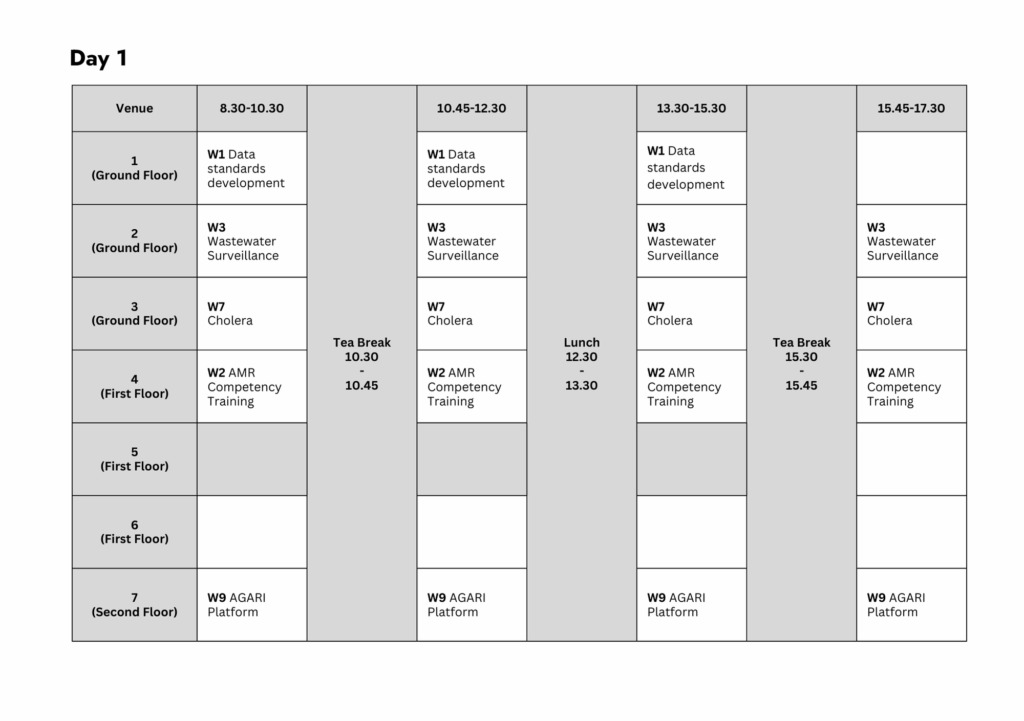
Workshop Schedule

Registration will take place from 7.00 – 8.00am in the entrance foyer of the Conference Centre. 

The programme begins with a group welcome session at 8:00 AM on Friday 24 October 2025.

Day 1 – Friday, 24 October 2025

Workshop 1: Data Standards Development

Time: 08:30 → 15:30
Venue: 1 (Ground Floor)

In the face of emerging pathogens, the ability to rapidly develop and apply contextual metadata standards is critical for effective public health response and data reuse. This 3 hour workshop will introduce participants to the principles and practices of metadata specification development, using the CIDGOH/PHA4GE 10-step process as a guide. Participants will examine real-world inconsistencies in public repositories and collaborate on building a contextual data standard for a fictional emerging pathogen, starting with limited clinical metadata and expanding to include environmental surveillance, including wastewater. There will be a section for open discussion of existing challenges and attendees are encouraged to bring their own datasets or projects for troubleshooting and feedback.

Topics:

  • Attend a short lecture on the value of metadata and the standard development process
  • Explore and critique existing metadata in public repositories (e.g. NCBI)
  • Collaboratively build a metadata specification in response to a staged pathogen scenario
  • Learn to incorporate wastewater-specific and environmental metadata
  • Receive supporting materials and templates for use in their own work

Format: Hands-on
Duration: 3 hours
Facilitators: Emma Griffiths, Finlay Maguire & Charlie Barclay
Prerequisites: Designed for researchers, data stewards, and public health professionals, the workshop emphasizes interoperability, ontology alignment (with OBO Foundry principles), and practical strategies for rapid contextual data specification design. No prerequisites required.

Workshop 2: Competency-Driven Genomics Training for AMR

Time: 08:30 → 17:30
Venue: 4 (First Floor)

This workshop introduces and applies the Pathogen Genomics Competency Framework (PGCF), developed to support workforce development across research, public health, and clinical domains. Using AMR as a thematic focus, participants will identify which competencies are most relevant for their roles and organisational needs, map existing capacities and gaps within their settings, and begin developing targeted, role-specific learning pathways.

Topics:

  • Resources for genomics and training in AMR
  • Role and challenges of competencies in genomics
  • Design Lab: From Competencies to Learning
  • Design Lab: Using competency-based approach to plan training

Format: Hands-on
Duration: 6 hours
Facilitators: Alice Matimba, Stanford Kwenda, Michelle Bishop
Prerequisites: This workshop is designed for professionals working in genomics, AMR surveillance, training, or health programme delivery. Participants are encouraged to join if they have:

  • Experience in public health, microbiology, genomics, bioinformatics, or AMR research
  • A role in training, curriculum development, or workforce planning
  • Interest in strengthening capacity-building efforts through targeted, competency-based approaches

Familiarity with genomics and AMR is recommended, but no prior experience with competency-based frameworks is required.

Workshop 3: Wastewater Surveillance (WWS) Data Analysis

Time: 08:30 → 17:30 (continues on Day 2)
Venue: 2 (Ground Floor)

Beginner to intermediate phase workshop on wastewater surveillance bioinformatics for public health.

Topics:

  • Introduction to WWS Epidemiology
  • Data standard/curation
  • Ethics for WWS
  • WWS Bioinformatics
  • Freyja

Format: Theory (minimal) and Hands-on
Duration: 10 hours
Facilitators: Keaghan Brown, Farzaana Diedericks, Tsaone Tamuhla, Gültekin Ünal, Dylan Pilz, Precious Adeyemi & Setshaba Taukobong
Prerequisites: Entry-level experience using the command line and some background in WWS.

Workshop 7: Cholera Bioinformatics

Time: 08:30 → 17:30
Venue: 3 (Ground Floor)

An overview of cholera genomic data generation, analysis and interpretation to inform public health and research needs.

Topics:

  • Cholera genomic data generation (sampling, bacterial isolation, DNA extraction, sequencing workflows)
  • Cholera genomic data analysis (analytical approaches and key resources)
  • Talk: How genomics is being applied to cholera
  • Discussion: Cholera genomics and metadata
  • Cholera metadata standards exercise

Format: Theory, Discussion and Hands-on
Duration: 8 hours
Facilitators: Jolynne Mokaya & Collins Tanui
Prerequisites: Professionals working on cholera.

Workshop 9: Africa CDC AGARI Data Platform Workshop

Time: 08:30 → 17:30
Venue: 7 (Second Floor)

For the past 5 years the Africa CDC has led a process of engaging stakeholders (genomics, bioinformatics and public health labs) in Africa to develop a shared vision for what countries need to use data for public health action. This led to a conceptual framework published in 2023 (Christoffels et al 2023). Since then a prototype and further development has taken place informed by a user-centric perspective. The first version of the Africa CDC-led AGARI data platform has been built to manage locally generated pathogen data for outbreaks.

This workshop will introduce participants to the functionality of the data platform and its national and regional configuration. Participants will get an opportunity to test the prototype and provide feedback to the software developers led by Hominum Global.

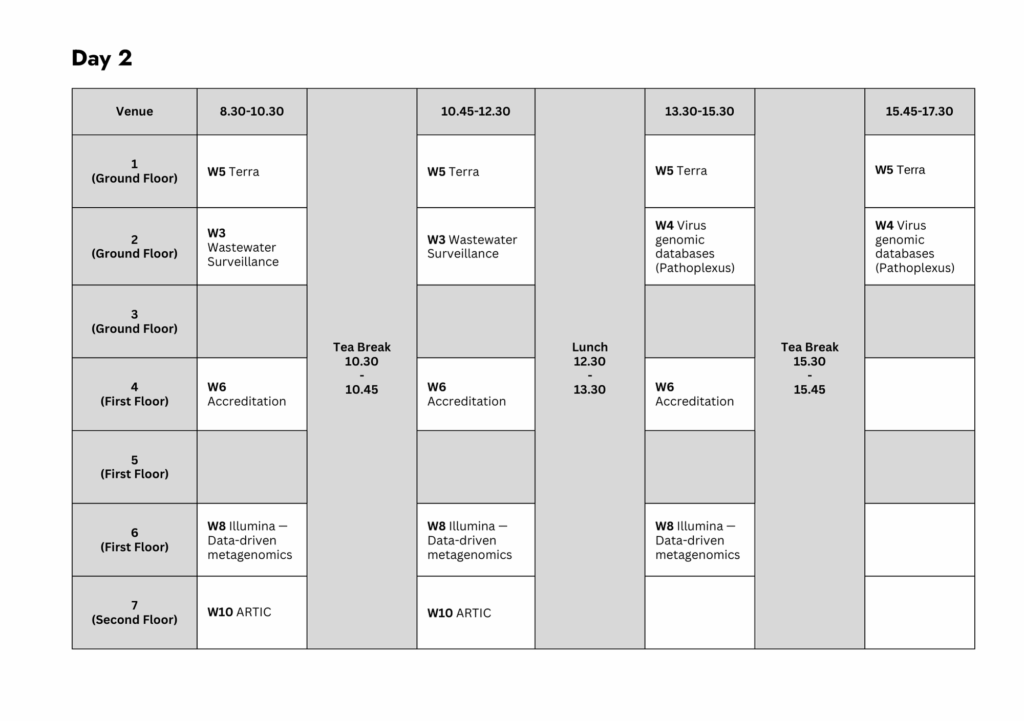
Day 2 – Saturday, 25 October 2025

Workshop 3: Wastewater Surveillance (WWS) Data Analysis

Time: 08:30 → 12:30 (continuation from Day 1)
Venue: 2 (Ground Floor)

See description under Day 1.

Workshop 4: Utilization of Specialised Virus Genomic Databases

Time: 13:30 → 17:30
Venue: 2 (Ground Floor)

An introduction to pathogen genomic data sharing using Pathoplexus.

Topics:

  • Overview of Pathoplexus
  • Data submission process
  • Troubleshooting tips

Format: Hands-on
Duration: 3 hours
Facilitators: Emma Hodcroft, Chaoran Chen, Arthur Shem Kasambula & Stephen Kanyerezi
Prerequisites: Familiarity with sequence file formats, basic knowledge of metadata standards, and a computer to download demo datasets.

Workshop 5: Pathogen Genomic Data Analysis in Terra

Time: 08:30 → 17:30
Venue: 1 (Ground Floor)

The Terra platform–a secure, cloud-based environment for genomic data management and analysis–is increasingly being used in the global public health genomics community, and enables users with or without bioinformatics training to navigate and analyse genomic data. This hands-on workshop provides an introduction to Terra and practical experience navigating the platform and using it to perform common analyses in pathogen genomics.

Topics:

  • An overview of Terra’s features and how to use the platform effectively
  • Accessing and leveraging pathogen genomics resources in Terra workspaces
  • Hands-on demonstrations with real-world datasets (cholera, malaria, SARS-CoV-2, Mpox)
  • Organising data, running analyses, exploring results, collaborating with others

Format: Hands-on
Duration: 5 hours
Facilitators: Gerald Mboowa, Danny Park, Bronwyn MacInnis, Jonn Smith
Prerequisites: All levels of bioinformatics experience welcome.

Workshop 6: Developing Bioinformatics Software for Accreditation

Time: 08:30 → 15:30
Venue: 4 (First Floor)

This workshop will introduce some of the key considerations when developing bioinformatics software for ISO accredited environments. The workshop will cover validation and verification, explore challenges with selected bioinformatics software, and identify how academic tools can be incorporated into service.

Topics:

  • ISO 15189 accreditation of genomics/bioinformatics
  • Validation and verification
  • Developing software in accredited environments
  • Building blocks for accredited pipelines
  • Tips for accreditable pipelines and infrastructure planning

Format: Theory and Practical/Workshop
Duration: 3–4 hours
Facilitators: Peter van Heusden, Dominique Anderson, Tom Connor, Buhle Ntozini & Sophia Bam
Prerequisites: Designed for both bioinformaticians and staff planning services. No expertise required.

Workshop 8: Keeping Up with Viruses — Data-Driven Metagenomics (Illumina Workshop)

Time: 08:30 → 15:30
Venue: 6 (First Floor)

This interactive workshop introduces Illumina’s Respiratory Pathogen ID/AMR Panel (RPIP) and Viral Surveillance Panel v2 (VSP2). Participants will review wet lab steps and use demo data on Illumina BaseSpace Sequence Hub (BSSH) to practice downstream analysis.

Topics:

  • Hybrid-capture enrichment for pathogen sequencing
  • RPIP: respiratory pathogens and AMR markers
  • VSP2: >200 high-risk viruses
  • Enrichment of RNA and DNA viruses from multiple sample types
  • Comparison with shotgun and amplicon sequencing
  • Data pipelines and epidemiological insights
  • Case studies on outbreak monitoring

Format: Interactive presentations, guided demos, and group discussions
Duration: 6 hours (with breaks)
Facilitators: Charles Kamau Wairuri, Natasha Kitchin
Prerequisites: Basic NGS and molecular biology knowledge, laptop with browser access.

Workshop 10: Can you stop an outbreak becoming a pandemic? An interactive genomics data interpretation exercise

Time: 08:30 → 12:30
Venue: 7 (Second Floor)

Description:

Join us for an exciting interactive exercise led by Prof Andrew Rambaut and Prof Nick Loman (ARTIC Network) who will lead participants through a fictional, but realistic, interactive outbreak scenario investigated with genomics. In small groups you will interpret data over the course of 3.5 hours to help understand the source and trajectory of a new outbreak. You will learn how metagenomic sequencing can be used to discover pathogens, how genome sequencing can help with epidemiological investigations, and how phylodynamic techniques can be used to determine outbreak parameters. The workshop will encourage discussion around interpreting results and making public health recommendations.

Format: Table-top exercise
Facilitators: Prof Andrew Rambaut and Prof Nick Loman (ARTIC Network)
Duration: 3.5 hours
Prerequisites: Prior experience in bioinformatics is not required. Participants should bring a laptop or tablet (shared or individual).

Poster Abstract deadline: Closed

Talk Abstract deadline: Closed

We welcome abstract submissions for poster presentations (to be presented as posters during poster sessions) and talks (to be presented as 15-minute oral presentations during thematic discussions) based on the tracks below:

Abstracts to posters:

  • Effective Decision-Making with AI & ML
    Harnessing artificial intelligence and machine learning for data-driven public health strategies.
  • Priority Pathogens and Diseases
    Addressing critical diseases such as malaria, sepsis, meningitis, cholera and any other priority pathogens.
    Track will also include abstracts focusing on: exploring bioinformatics pipelines, ethical and legal considerations (ELSI), data repositories, infrastructure needs, and data standards.
  • One Health and Surveillance
    Innovative surveillance strategies for detecting and mitigating public health threats.
  • Funding and Cost Management
    Exploring sustainable funding models, investment opportunities, and scaling solutions.
  • Data Sharing: Challenges and Opportunities
    Enhancing inter-agency, local, national, and global collaboration through best practices in data sharing.
  • Workforce Development
    Strengthening the public health workforce through training and capacity-building initiatives.
  • Policy-Making for Advancing Public Health Genomics
    Developing policies that drive local and global implementation of genomic epidemiology.

All abstracts must be in English.

Detailed guidelines on the correct abstract format for posters can be downloaded here

Poster abstract submissions are closed.

Successful individuals will be emailed on the outcome. For any other enquiries relating to abstracts applications or abstract submissions, please email [email protected] 

Instructions for preparing and submitting PHA4GE Conference 2025 Posters

The upload deadline for posters is 15 August 2025.

Full Poster Instructions

Instructions for preparing and submitting PHA4GE Conference 2025 Talk Presentations

Full Talk Instructions

Registration Fees:

International Delegates – R6500 ZAR
*Any country not on the LMIC list

Low & Middle Income Countries – R3500 ZAR

Please refer to the World Bank’s Income Groups

Students – R1800 ZAR
*Kindly note you will be required to submit proof of registration at any university in the world

Workshop – R1800 ZAR**
**2-day workshop event – 24th and 25th October 2025

Poster printing costs are included in the registration fee for all approved Conference poster abstracts!

For any queries relating to registration please email: [email protected]

Conference Programme

Day 1

TimeSession
08:00 – 09:00Registration and Refreshments
09:00 – 09:30

Opening Remarks

  • Mrs Shenaaz El-Halabi – WHO Country Office South Africa Representative
  • Dr Belizaire Marie Roseline Darnycka – WHO AFRO 
  • Oliver Morgan – WHO Hub
  • Prof Alan Christoffels – PHA4GE
  • Security Briefing
09:30 – 10:00

Keynote Presentation

Prof. Placide Mbala (INRB, DRC)


10:00 – 10:30IPSN Introduction to Pathogen Genomics Strategy Roadmap 
10:30 – 11:00Tea Break and Group Photo
11:05 – 12:25

Genomics Challenges with Data

  • Moderators: Emma Griffiths (PHA4GE), Timothy Dallman (IPSN)
  • Panelists:
    • Sofonias Tessema (Africa CDC)
    • Charlie Barclay (GA4GH/PHA4GE)
    • Emma Hodcroft (Pathoplexus)
    • Peter Woollard (EBI)
12:30 – 13:30Lunch
13:30 – 14:45

Priority Pathogens/Diseases (PART 1: Interoperability)

  • Emma GriffithsBetter structure, better function: Improving data interoperability and usability with PHA4GE data standards
  • Charlie BarclayTowards Interoperable and FAIR Wastewater Genomic Surveillance: The PHA4GE Wastewater Contextual Data Specification
  • Eddie LulambaAdvancing Malaria Genomic Data Standards: An African Perspective
  • Dominique AndersonDevelopment of neonatal specific metadata standard schema for global genomic surveillance programmes of neonatal sepsis
  • Collins TanuiFrom Fragmentation to Integration: Advancing Cholera Surveillance Through Metadata Standards
  • Hina SalimuddinKlebNET Metadata Repository: Enhanced Contextual Data for Klebsiella pneumoniae Species Complex Genomes
14:45 – 15:05Q&A (20 min)
15:10 – 16:10Poster Session & Tea/Coffee Break
16:15 – 17:25

Priority Pathogens/Diseases (PART 2)

  • Gültekin Ünal – Collaborative Solutions for Genomic Epidemiology: Contributions from the PHA4GE Bioinformatics Pipelines and Visualisation Working Group
  • Kathryn MurieEmpowering Plasmodium Genomic Surveillance with an Open-Source Analysis Ecosystem and Curated Data Standards
  • Noof Bani KhaledGenomic Detection of Rare ST547 Among MDR Acinetobacter baumannii Isolates at a Malaysian Hospital
  • Racheal Claire KyomukamaDiscovery of Synergistic Drug Combinations For E. coli from Drug Information, Pathogen Response and Disease Microenvironment Data
  • Emma HodcroftPHA4GE Data Repositories Working Group – Pathoplexus: A Community-Driven Solution for Transparent and Equitable Viral Genomic Data Sharing
17:25 – 17:45Q&A (20 min)
18:00 – 20:00Social

Day 2

TimeSession
09:00 – 09:45

Infrastructure to Support Public Health

  • Peter van HeudsenNot all those who wander are lost: PHA4GE Infrastructure Working Group guidance for growing public health genomic sequencing efforts
  • Chaoran ChenGenSpectrum: dashboards for genomic epidemiology
  • Karin LagesenTransdisciplinary Collaboration and Data Democratization for Genomic Pathogen Surveillance
  • Clare SloggettBuilding AusTrakka: lessons learnt from six years of deploying a national genomic data sharing and surveillance platform
09:45 – 10:00Q&A (15 min)
10:00 – 10:55

Public Health Infrastructure – Panel Discussion

  • Moderators: Nicola Mulder (PHA4GE/UCT)
  • Panelists:
    • Torsten Seeman (Doherty Institute)
    • Karin Lagesen (Norwegian Veterinary Institute)
    • Tulio Campos (FioCruz)
    • Stephen Kanyerezi (CPHL Uganda)
    • Áine O’Toole (University of Edinburgh)
10:55 – 11:25Tea Break
11:30 – 12:40

One Health and Surveillance

  • Nicki TiffinTranslating Principles to Practice: Operationalising Ethics and Equity in Microbial Data Sharing
  • Natalie GrovesUsing a One Health Approach to Genomic Risk Assessment of A(H5N1) for a UK Human Case
  • Idrissa DiengWaiting in the Wings: The Resurgence of Sylvatic Dengue Virus in Senegal within a Hyperendemic Context
  • Celeste DonatoThe design and implementation of a One Health genomic surveillance program in Australia
12:40 – 12:55Q&A (20 min)
12:55 – 13:55Lunch
14:00 – 15:05

Workforce development

  • Workforce development IPSN – Training and Competencies working group
  • Nicky MulderBuilding Capacity in Pathogen Surveillance: Insights and Innovations from the PHA4GE Training Working Group
  • Keaghan BrownBeyond the Lecture: Comprehensive Training Approaches for Public Health in Wastewater Surveillance Bioinformatics
  • Gladys IbrahimScaling Genomic Workforce Capacity in Africa through Youth-Driven Solutions: CoGSAYR as a Model
  • Oliver De SousaAn AI Chatbot to support pathogen genomics trainees
  • Julia PringleTabletop exercises: a tool to facilitate collaboration between laboratorians and epidemiologists working in genomic epidemiology
15:05 – 15:20Q&A (15 min)
15:20 – 16:20Poster Session & Tea/Coffee Break
16:25 – 18:00

IPSN – Sample to Data Breakaway Sessions (Breakout)

PHA4GE Working Groups’ Breakaway Sessions

Day 3

TimeSession
09:00 – 09:40

Policymaking for Advancing Public Health Genomics

  • Josefina Campos – Setting the scene, insights to action
  • Massab Umair – Strengthening National Preparedness: The Development of Pakistan’s Pathogen Genomic Surveillance Strategy
  • Sabrina Weiss – Challenges and Opportunities in Operationalising Genomic Surveillance in Africa: Transnational perspectives from Côte d’Ivoire, Madagascar, Namibia, and The Gambia
  • Francis Chikuse – Policy and Action: Integration of genomics into existing public health frameworks in Africa through development of national strategies
09:40 – 09:55Q&A (15 min)
10:00 – 10:35Investment and Funding – Panel Discussion
10:35 – 11:05Tea Break
11:10 – 12:35IPSN – Insights to Action
12:35 – 13:35Lunch
13:40 – 14:00IPSN Insight to Action Recap
14:05 – 14:35

The IPSN Catalytic Grant Fund: Project Showcase

  • Gary Wong – Environmental genomic surveillance of avian Influenza A viruses in high-risk live-bird markets in Laos: an innovative sequencing approach
  • Filipe Moreira – Development of an offline-capable computational framework for decentralised real-time untargeted pathogen genomic surveillance
  • Rodrigue Ayagirwe – Generating genomic surveillance data of pathogens in Democratic Republic of Congo by extending the Mini-Lab with a Nanopore MinION sequencer
14:35 – 14:50Q&A (15 min)
14:50 – 15:20

Keynote Presentation

Prof Nicaise Ndembi (IVI Africa Regional Office)

15:20 – 15:35Closing Remarks
15:35 – 16:05Tea Break
16:01 – 17:10IPSN CoP data–CSUA breakout sessions

Opening Keynote

Prof Placide Mbala Kingebeni

Kinshasa University Medical School

Biosketch
Dr. Mbala has extensive experience in medical biology, with specific training and expertise in microbiology, virology, and outbreak investigations. His research focuses on viral zoonoses with risk factors for human contamination. As principal investigator and co-investigator for several universities and US-funded grants, Dr. Mbala laid the groundwork for his research projects in very remote areas of the DRC where most outbreaks occur. He has contributed to several research projects including clinical and genomic characterization of zoonotic viral pathogens such as Ebola, mpox virus, SARS-CoV2, etc.

Currently, Dr. Mbala, as principal and co-principal investigator, is leading several research studies in collaboration several research institutions in Africa, Europe, Asia and Arimerica.

Dr Mbala was awarded by Nature’s 10 among people who shaped Science in 2024 and by Time 100 Health 2025 among The Most Influential People in Health of 2025. He has published over 100 journal articles and holds a Master in Science of Public Health from the Institute of Tropical Medicine of Antwerp and a Doctor of Health Biology from University of Montpellier. He is Lecturer at the Institute of One Health of Africa, University of Kinshasa, Lecturer for the International University Degree: Emerging Infections – One Health Approach by the Medical School of the University of Montpellier, Guest lecturer at the Institute of Tropical Medicine in Antwerp, Guest lecturer at the Epidemiology Department of the University of California Los Angeles, Visiting Professor at Osaka Metropolitan University, Extraordinary Professor at the South African National Bioinformatics Institute, University of the Western Cape.

Closing Keynote

Prof Nicaise Ndembi

IVI Africa Regional Office

Biosketch
Professor Nicaise Ndembi, Ph.D., is the Deputy Director General and Regional Director of the IVI Africa Regional Office, based in Kigali, Rwanda. 

Prof. Ndembi is also an Associate Professor at the Institute of Human Virology, University of Maryland School of Medicine as well as a Research Professor at the Kanazawa University School of Medicine, Department of Viral Infection and International Public Health, where he completed his doctorate in molecular virology. 

Prior to joining IVI in 2025, Prof. Ndembi was the Principal Advisor to the Africa Centres for Disease Control and Prevention (Africa CDC)’s Director General, where he established the Partnerships for Africa Vaccine Manufacturing (PAVM), creating a framework for regional vaccine manufacturing and self-reliance. He additional held the position of Deputy Incident Manager mpox – Marburg Continental Prevention Preparedness and Response Plan for Africa.

Prof. Ndembi has authored and co-authored over 300 peer-reviewed papers and chapters in professional journals. He is the Editor-in-Chief of the Journal of Public Health of Africa as well as AIDS Research and Therapy. And he has been named to the 2025 TIME100 Health list – recognizing the 100 most influential people in global health and also 100 Most Notable Peace Icons in Africa, 2025 list.
PHA4GE Secretariat

Alan Christoffels

PHA4GE

Gabrielle Arendse

PHA4GE

Jamie Southgate

PHA4GE

Michael Bridger

PHA4GE

Nawaal Weitz

PHA4GE

Rangarirai Matima

PHA4GE

Tracey Calvert-Joshua

PHA4GE

Zenande Mgijima

PHA4GE

Farzaana Diedericks

PHA4GE

Keaghan Brown

PHA4GE

Scientific Committee

Alan Christoffels

PHA4GE

Tim Dallman

IPSN

Finlay Maguire

Dalhousie University

Gültekin Ünal

Ankara University

Josefina Campos

IPSN

Jamie Southgate

PHA4GE

Keaghan Brown

PHA4GE

Tracey Calvert-Joshua

PHA4GE

Meera Chand

UKHSA

Dhamari Naidoo

WHO

Rangarirai Matima

PHA4GE

Sabrina Weiß

Robert Koch Institute

Event Coordinator


When it comes to conference centres in Cape Town, you’re spoiled for choice. If you’re trying to decide which of the many facilities to book situated in and around the Western Cape that will cater to all your event needs and more, Century City’s Conference Centre stands out as being one of the best that Cape Town has to offer.

An award-winning function venue that is versatile, high-tech, personal, fully equipped and sustainable, Century City Conference Centre boasts an ideal central location at the heart of Cape Town’s vibrant Century City precinct, and is conveniently situated close to all of the Mother City’s key travel services and attractions.

Voted as Africa’s most sustainable venue in 2019, Century City Conference Centre is the only conference centre in Cape Town that has been developed as part of a mixed-use development with the award of a 4-Star Green Star Certification by the Green Building Council of South Africa.

Accommodation:
While we have listed some recommended accommodation, delegates are free to secure accommodation of their choice. 


Cape Town is located in the southernmost tip of Africa which is one of the most magnificent parts of the world, a paradise full of exquisite scenery and beautiful beaches.

Cape Town is known for its natural beauty, its juxtaposition of mountains and beaches, its art and its diverse people. With its larger-than-life mountain overlooking the City Bowl, harbour, white beaches and Robben Island beyond, this is a tourists’ playground.

There is nowhere quite like Cape Town. It is therefore no surprise that this coastal gem, crowned by the magnificent Table Mountain National Park, has been voted the best city in the world seven years running!

Attractions

Evergreen attractions like the penguin colony at Boulders Beach, the breathtaking views from Table Mountain, the delicious cuisine at Gold Restaurant, the white sands of Camps Bay, and the beautiful scenery of the Cape of Good Hope where the Indian and Atlantic oceans meet, continue to wow visitors to Cape Town.

Places to visit

  • Table Mountain
  • Camps Bay & Clifton 
  • V&A Waterfront
  • Robben Island
  • Boulders Beach
  • Lion’s Head
  • Kirstenbosch Botanical Gardens
  • Cape Point
  • The winelands –  Franschhoek & Stellenbosch
  • Bo-Kaap


For more information visit Cape Town Tourism


Safety

Cape Town is a vibrant, modern, and cosmopolitan South African city. We encourage visitors to exercise the same level of awareness and common-sense precautions they would in any major city worldwide.

Practical safety tips include keeping local emergency numbers handy, avoiding carrying large amounts of cash, and keeping your valuables secure at all times. For the overwhelming majority of the 1.7 million international visitors to the Western Cape in 2018, their experience was both positive and memorable.

Regularly ranked among the world’s top holiday destinations, Cape Town enjoys a high return visitor rate, a testament to the fact that those who visit often fall in love with the city and are inspired to return.

You can view the official Cape Town Tourism Safety Guide for more information

Registration and deadlines
Deadlines

Talk Abstract Submission
Closed

Poster Abstract Submission
Closed

Registration
Closed

Follow PHA4GE