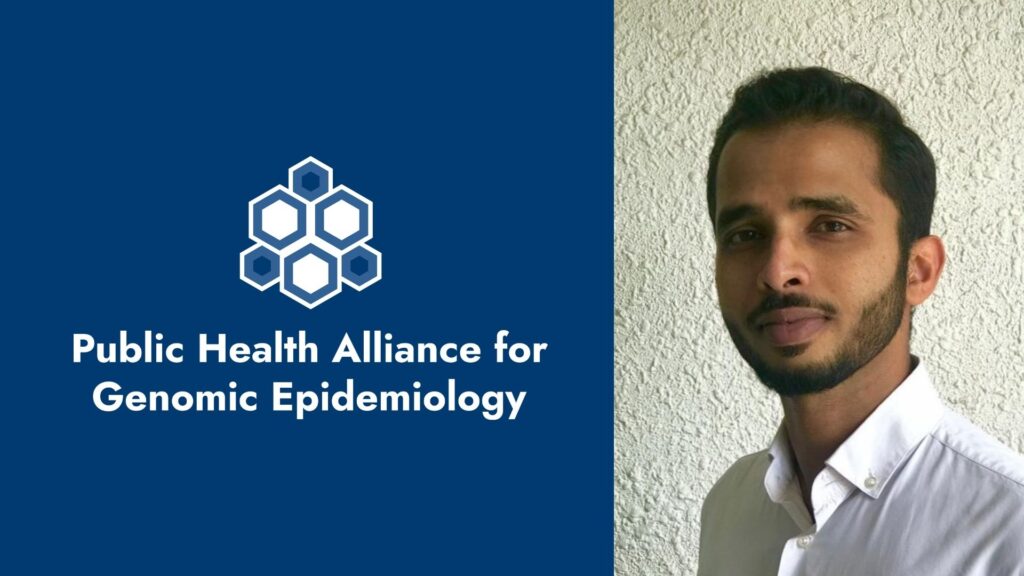
Dr Shurendar Selva Kumar has been appointed as a postdoctoral research fellow to lead the development of a Mycobacterium tuberculosis standard specification, to be built on PHA4GE’s foundations. Based at the Duke NUS Medical School in Singapore, he will drive the project from within the Asia Pathogen Genomics Initiative (Asia PGI), a flagship initiative of the Duke-NUS Centre for Outbreak Preparedness (COP). We conducted a short interview with him.
PHA4GE: Tell us a little about your background.
SHURENDAR SELVA KUMAR: I grew up in a very small town about an hour away from the capital of Malaysia in Kuala Lumpur. I trained in medicine at the Royal College of Surgeons Ireland (RCSI) and University College Dublin (UCD) Malaysia campus in the north of Malaysia, and qualified as a medical doctor in 2014. I spent my early years as a clinician in Malaysia itself, working as a medical officer in a state called Sabah in Malaysia. It’s a fairly resource limited setting. So that’s really where I got to see how a lot of patient outcomes are really decided upstream, in terms of social determinants of health and how you plan your health system, basically at the level of systems and prevention, rather at the bedside. My career was mostly spent working in the Ministry of Health of Malaysia, as well as the World Health Organisation (WHO), before I had at short stint at a health startup.
PHA4GE: You did your master’s in public health at Imperial College London over 2020 and 2021, looking at measles vaccine coverage. Tell us about that work.
SSK: A big problem in Sabah at that point of time, and probably globally and internationally as well, was vaccine hesitancy. We used to see a lot of kids with measles at a time when we were doing so well in vaccine coverage, and suddenly we started seeing this resurgence in cases. So it was a bit of a stress test as to how well the vaccination program in Malaysia was performing. On paper it looked like it was doing quite well, but we were seeing quite a lot of these cases on the ground. So my dissertation looked at estimating effective coverage in Malaysia, working with a mathematical formula that looked at dose correlation and vaccine efficacy.
PHA4GE: You are now an assistant professor with COP at Duke-NUS Medical School in Singapore. Tell us a little about your work there.
SSK: I first joined COP in 2024 as a research fellow. What’s interesting about COP is that it sits at this intersection between academia and regional operational impact. My brief includes improving access to pathogen genomics and driving TB genomics implementation across Asia through strategic partnerships. So I get to work with a lot of the stakeholders that I was already working with from my time at WHO, including ministries of health, private organisations, regional bodies. In many ways, pathogen genomics was new to me. Essentially, I was working a lot on surveillance before, of both communicable and non-communicable diseases. But pathogen genomics is a whole new world in that way. I also do work around market shaping, so my main stakeholders for that are sequencing manufacturers. And what we try to do is work with manufacturers and countries to try and bring down costs and improve access to these technologies for our partners, with tuberculosis being a very important use case in that sense. We have stakeholders from government, from outside of government, a really strong set of stakeholders who are leading implementation within the within the region itself. In Asia, the biggest burden of TB is in Philippines, Indonesia, India.
PHA4GE: What are the levels of pathogen genomics uptake in the region?
SSK: I think it’s still very early in in terms of implementation on of genomics, not just for TB but a lot of other different pathogens as well. It was used before for diseases like polio, and then for COVID. But it is yet to be used routinely, that means within diagnostic algorithms within countries itself. Still, there’s quite a bit of barriers for us to address mainly around cost, standardisation, data, and capacity before we see it being adopted routinely, and that’s really what we’re trying to accelerate at Asia PGI and COP.
PHA4GE: Tell us a little more about the project you are doing with PHA4GE.
SSK: The project essentially deals with metadata standardisation, among other things. What we are seeing is that a lot of the time we are unable to compare the data that you generate from TB genomics implementation from within one country, with the work being done another country. That’s because of how disparate or differently they collect data, for example. So, we’re trying to standardise metadata collection and management so that it aligns with international data systems and data specifications. Then not only are you able to do comparative assessments nationally, but you can start doing it globally and regionally as well. So that’s really what we’re trying to do within the Asia PGI network.