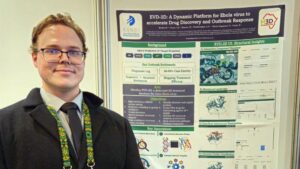
Taiwo Omomule is leading a PHA4GE project to bring AI into disease surveillance but, the postdoc explains, his path into public health took a few detours.
The AI bug didn’t bite early for Taiwo Omomule.
For a while, he was pursuing established computer-science interests. As an undergraduate at Adekunle Ajasin University in Nigeria, his final project, completed in 2012, concerned the development of randomisation algorithms to improve the diversity of online examination question banks. A few years later, when he started his master’s studies at the country’s Federal University of Technology Akure in 2016, he turned his attention to information security and cloud computing, looking into ways to better secure sensitive credit card information on the cloud.
But a talk he attended, on the Naïve Bayes algorithm, considered a cornerstone algorithm of machine learning, inspired not just a solution to a thesis hiccup, but also a change in career trajectory. “It was my first time hearing of machine learning,” Omomule recalls.
His curiosity piqued, he started reaching out across Africa, and elsewhere, looking to find machine-learning authorities at whose feet he could learn more about the subject. Which is how he ended up at Stellenbosch University (SU) in South Africa in 2019, working under the tutelage of renowned Professor Andries Engelbrecht. Engelbrecht had just taken up the Voigt Chair in Data Science at SU, after holding the South African Research Chair in Artificial Intelligence at the University of Pretoria for over a decade.
“I wasn’t really concerned about the country or the laboratory,” Omomule says of his move to South Africa. “My interest was in getting someone who is experienced in that field.”
He dedicated his PhD to data science and machine learning. After which he started looking around to see where he could apply his newfound skills. “By then I had worked largely on the science of data science, investigating the foundational performance issues, and inductive biases of various classic machine-learning algorithms.”
While studying, Omomule had joined a start-up at Stellenbosch University, exploring, among other things, machine-learning-based market analytics to evaluate Airbnb property utilisation, rental demand, and market trends. When he wrapped up his PhD in 2022, he first worked as a data scientist with the Peace Research Institute in Oslo, Norway. He then headed for Canada as a postdoctoral researcher at the University Guelph, where he investigated how machine learning could be applied to studying the impact of climate change of agro-environmental productivity. These experiences helped him realise his goal to gain research and technical experience at the intersection of machine learning, remote sensing, and geospatial analytics.
His work in Canada was, Omomule adds, closer to a dream job he had long imagined. “I had always had a thing for applied AI in public health and climate-driven geospatial dreams.”
Which is why he headed to the South African National Bioinformatics Institute (SANBI) at the country’s University of the Western Cape (UWC), also host to the PHA4GE Secretariat, in 2025. Here, he began to apply machine learning to genomic and clinical datasets, and the development of tools that could automate the many parts of a bioinformatics pipeline. He is currently developing a multi-agent model, in which different AI agents would be responsible for different tasks.
“The idea is to build a distributed system, where all of these processes could be performed in parallel,” Omomule explains. “That way you’re automating the whole architecture, the whole workflow.”
A key output of his time at SANBI was the development of an AI-chatbot for cholera disease surveillance, using Large Language Models (LLMs) . The chatbot reduced the generation of an outbreak report, of the kind used by public-health stakeholder, by as much as 60%.
This model will now form the premise of PHA4GE’s new AI in Public Health Bioinformatics project, funded by the Gates Foundation. Omomule will lead a team of postdoctoral researchers who will develop fully validated AI‑driven bioinformatics pipelines for at least five priority diseases, benchmarked against gold‑standard manual workflows.
“What we are trying to do is build a system that can perform all the bioinformatics tasks with less error, quicker implementation, and better outputs,” explains Omomule.
Yes, in many ways, it is a dream come true. For me, it is about making AI useful beyond the laboratory. My greatest satisfaction comes from knowing that the skills I have spent years developing can contribute to improving public-health outcomes, which also gives my research a deeper sense of purpose.