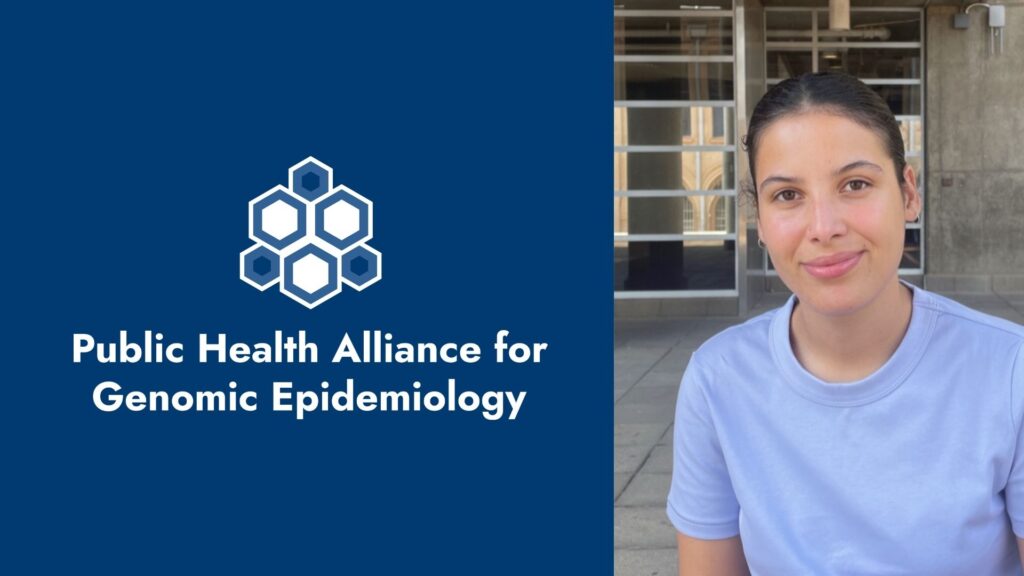
Every member of the PHA4GE community brings a unique perspective to the field of genomics, shaped by their own experiences, interests and research journey. In this Member Spotlight, we introduce Khaleila Fleischer, an early-career scientist whose work spans bioinformatics, human genetics and disease research.
Passionate about understanding how genomics can advance human health, we caught up with Khaleila to learn more about her journey into research, what inspires her, and the path that has brought her to where she is today.
INTERVIEWER: To start us off, could you tell us a little about yourself and your current role? We’d love to hear about what you do, where you’re based and the work you’re currently involved in.
KHALEILA FLISHER: I am an early-career scientist with a passion for all things research! I have a particular interest in bioinformatics, human genetics and disease research. My work has focused on the genetics of kidney disease and Parkinson’s disease, where I have explored the role of genetics in understanding human health and disease. This year, I’m broadening my research experience by branching into clinical research to gain experience in translating genomic scientific discoveries into patient-centred research.
I: What first sparked your interest in human genetics, and was there a particular person or experience that inspired you to pursue this path?
KF: I have always been fascinated by the power of genetics and its potential to advance our understanding of human disease. During my undergraduate studies, I was particularly inspired by my female lecturers, whose accomplishments, research and passion for science left a lasting impact on me. Seeing women leading impactful research and making important scientific contributions strengthened my ambition to pursue a career in this field.
I: Your work sits at the intersection of human genetics, bioinformatics and disease research. What is it about this area that you find most exciting or meaningful?
KF: What excites me most about this area is how much there is still left to discover. As DNA
sequencing becomes more accessible and technologies continue to advance, we have an
extraordinary opportunity to uncover new insights that were previously out of reach.
Bioinformatics is crucial for making sense of complex datasets, allowing us to gain
meaningful biological insights that deepen our understanding of disease.
I: Can you tell us about some of the projects or research you’re currently working on? Is there one you’re particularly proud of?
KF: I’m particularly proud of my contribution to the Parkinson’s disease research group at
Stellenbosch University (SU). Recently, the lab and I published a paper highlighting the work
done conducted by the group over the past 20 years under the leadership of Prof. Soraya
Bardien. The lab established a study collection of almost 2,000 individuals and completed
complementary genetics, functional and therapeutic studies to advance our understanding
of the disease in South African populations. Writing about this work was a particularly
rewarding experience as it allowed me to reflect on the large impact smaller laboratories in
low-resource settings can have.
I: What inspired you to join the PHA4GE community, and what are you hoping to gain from being part of the network?
KF: PHA4GE’s commitment to advancing public health through using genomics and bioinformatics was what initially drew me to the community. Its emphasis on open science
and collaboration closely aligns with my values as a researcher. While I am new to the
PHA4GE community, I look forward to making meaningful connections.
I: Collaboration is such an important part of genomics and bioinformatics. How has working with researchers from different institutions and disciplines shaped your perspective?
KF: Having studied at UCT, SU and WITS, I have been exposed to a plethora of researchers and research areas. With each new environment I have broadened my research interests, skills and capabilities. It taught me how to be more adaptable and to not be afraid of a challenge. Overall, it has made me into a more well-rounded and knowledgeable researcher.
I: Looking ahead, what developments in human genetics, bioinformatics or disease research are you most excited about?
KF: One of the developments I’m most excited about is the increasing representation of African, and particularly South African, populations in genomics research. As more diverse genetic data becomes available, we have an opportunity to better understand how diseases affect our communities and ensure that future advances in genomics are relevant to our
populations.
I: What advice would you give to students or early-career researchers interested in pursuing a career in bioinformatics or human genetics?
KF: Be open to learning about new methods or research areas because this is where you’ll learn to grow the most as a scientist.
I: Finally, outside of research, what are some of your interests or hobbies?
KF: I play on a soccer team and also play socially on my days off. I also enjoy walks in the forest and swimming in the ocean (when the Cape Town weather cooperates!)