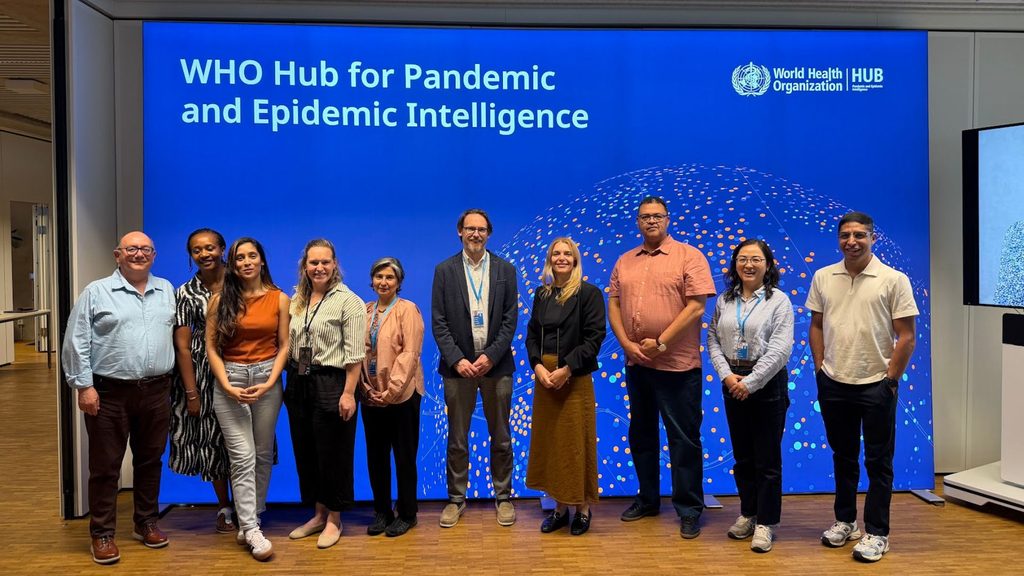
A delegation from the Public Health Alliance for Genomic Epidemiology (PHA4GE) travelled to Berlin in early September for a series of meetings aimed at strengthening international partnerships and shaping the organisation’s priorities for the years ahead.
At the centre of the visit were discussions with the World Health Organization’s International Pathogen Surveillance Network (IPSN), held at the WHO Hub for Pandemic and Epidemic Intelligence.
The meetings brought together PHA4GE and IPSN representatives to explore areas where the two organisations could work more closely, from data standards and workforce development to the emerging role of artificial intelligence in pathogen surveillance.
“Our missions are very much aligned,” said Dr Josefina Campos, unit head for genomics and analytics at the WHO.
PHA4GE Executive Director Prof Alan Christoffels was joined by Dr Tracey Calvert-Joshua, programme lead; Michael Bridger, business development lead; and Jamie Southgate, operations lead.
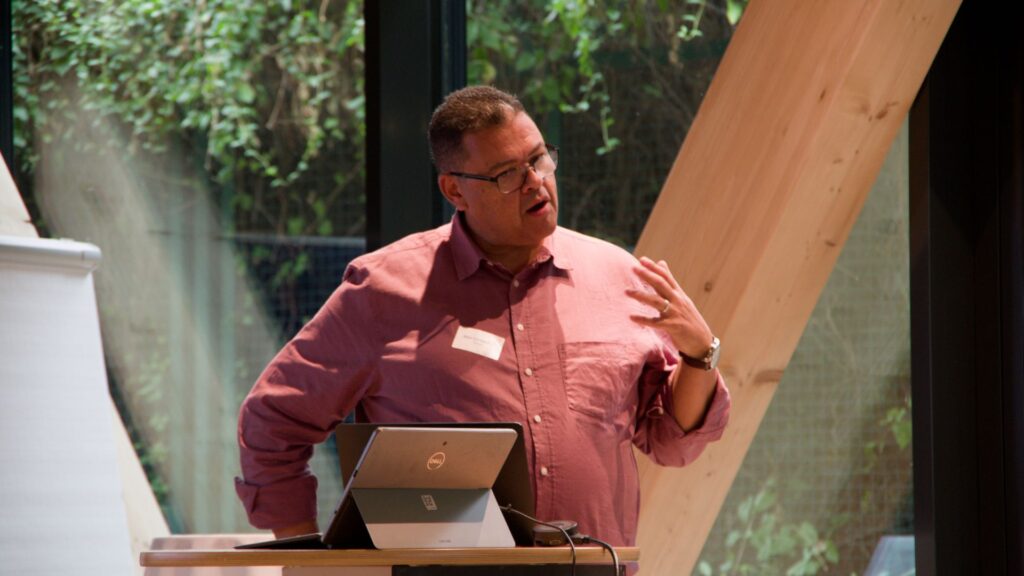
The delegation also met Dr Timothy Dallman, senior technical adviser to IPSN, while Prof Christoffels gave an introductory presentation on PHA4GE’s work to colleagues from across IPSN and the WHO Hub.
For PHA4GE, the discussions reflected a wider question facing the pathogen genomics community: how to ensure that advances in genomic surveillance translate into meaningful improvements in public health.
“What has been really clear from the meetings is that there is a collective interest in ensuring that what we develop as a computational biology community in the genomic epidemiology space needs to impact public health,” Prof Christoffels said.
That challenge has become increasingly prominent as pathogen genomics has taken on a greater role in outbreak preparedness and response.
“There seems to be a shared understanding that we need to build the tools, but also the mechanisms through which public health can respond rapidly,” Prof Christoffels said.
The Berlin visit also took the delegation to the Gerichtstraße site – which now accommodates the Department of Epidemiology and Health Monitoring, and the Centre for International Health Protection (ZIG) – of the Robert Koch Institute (RKI). Prof Christoffels had been invited by Dr Sabrina Weiß, head of Public Health Laboratory Support at the ZIG, to present PHA4GE’s work at the “Back to Base: MF1 Alumni Meeting” symposium.
The RKI visit also opened up discussions beyond the technical aspects of genomic surveillance.
One conversation, with social anthropologist Dr Lenka Körner, focused on the need to rethink how genomic epidemiology is taught and to give greater attention to the social consequences of surveillance technologies.
The discussion explored how public-health genomics curricula could draw more strongly on the social sciences, particularly when considering questions of trust, communication and the potential stigma that can accompany disease surveillance.
For PHA4GE, such questions sit alongside the technical challenges of building interoperable systems, developing common standards and strengthening genomic capacity across different regions.
The Berlin meetings are expected to feed into continuing discussions between PHA4GE, IPSN and other partners on how those priorities can be translated into practical collaboration.
The discussions pointed to a broader ambition: ensuring that the tools, standards and expertise being developed by the global genomics community ultimately strengthen the way public-health systems prepare for and respond to disease.