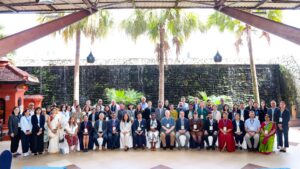
South Africa hosted the launch of the next step of a project that looks to develop and implement bioinformatics accreditation in laboratories around the globe. Beautiful
Medical laboratories have well-established, internationally validated accreditation processes that ensure the results generated in those facilities are of the highest, widely accepted quality.
But those accreditation standards – known as ISO 15189 for medical labs, and ISO 17025 for testing and calibration – apply largely to traditional wet-lab workflows. As yet, dry-lab processes, notably laboratories’ bioinformatics pipelines, have no such stamp of approval, largely because of the more recent advent of genomics and bioinformatics as laboratory disciplines that add value to clinical interventions.
The advISO bioinformatics accreditation in a box project, informally known as ISO in a Box, aims to set that right. Cardiff University in Wales successfully accredited its public health laboratory to use TB bioinformatics pipelines and has expanded its accredited processes to other pathogens. This work formed the basis of a Wellcome Trust-funded international project In 2024 to integrate bioinformatics into those ISO 15189 and ISO 17025 standards. The advISO project, led by Cardiff University in Wales, includes SANBI-UWC in South Africa and the Wellcome Sanger Centre in the UK. Phase 1 developed tools and training resources, covering everything from competencies to technologies, to help medical laboratories, notably those in resource-limited settings to secure ISO 18189 and ISO 17025 accreditation.
With those tools now prepared, the South African National Bioinformatics Institute (SANBI) at the University of the Western Cape, former headquarters for the PHA4GE Secretariat, hosted the next step of the project at a meeting in October – namely the onboarding of pilot sites in Africa and Asia. These pilot sites will be at public-health laboratories in Bangladesh, Ethiopia, South Africa, The Gambia, and Uganda.
“These are sites that have ambitions to secure accreditation for the pathogen genomics services,” explains Professor Thomas Connor, advISO co-lead with SANBI’s Professor Alan Christoffels, Dr Dominique Anderson and Mr Peter van Heusden. “The idea is that we are going to help them apply our tools in their settings, and they’re going to feed back to us, allowing us to improve our tools, making them better, make them more generalisable, so that they can be taken up by other laboratories around the world.”
A key part of this process will be documenting standard operating procedures (SOPs), adds Christoffels. “So the pilot sites will use our SOP templates to build their own.”
This stage offers an opportunity for laboratories in Asia and Africa to not just catch up with facilities in the global north, but also improve on implementation there, says Dr Abdul Karim Sesay of the Medical Research Council Unit The Gambia (MRCG) at the London School of Hygiene & Tropical Medicine (LSHTM).
“You will often hear the term ‘leapfrogging’ being used,” notes Sesay. “That means that we don’t have to reinvent and follow the same things, that we can see what has worked for them and adapt those processes to our own context.”
If well implemented, the project will bring greater equity to laboratories and the services they offer around the world, adds Connor. “The question we are trying to address is why should a patient in a place like the UK have the assurance that their tests are being conducted in an accredited lab, whereas a patient in Africa may not have that assurance?”