
As if rubbing shoulders with some of the leading voices in his field wasn’t enough, PHA4GE member Dylan Pilz made his first visit to Ghana a truly memorable one by picking up the award for best poster presentation at the Wastewater & Environmental Surveillance Meeting 2026.
Held in Accra on 14 and 15 April 2026, the conference listed among its objectives the bridging of the gap between cutting-edge wastewater and environmental surveillance (WES) science and “actionable public policy”. Hosts included the Gates Foundation, the Ghana Ministry of Health, Scripps Research in the US, and the World Health Organisation African Region (WHO AFRO).
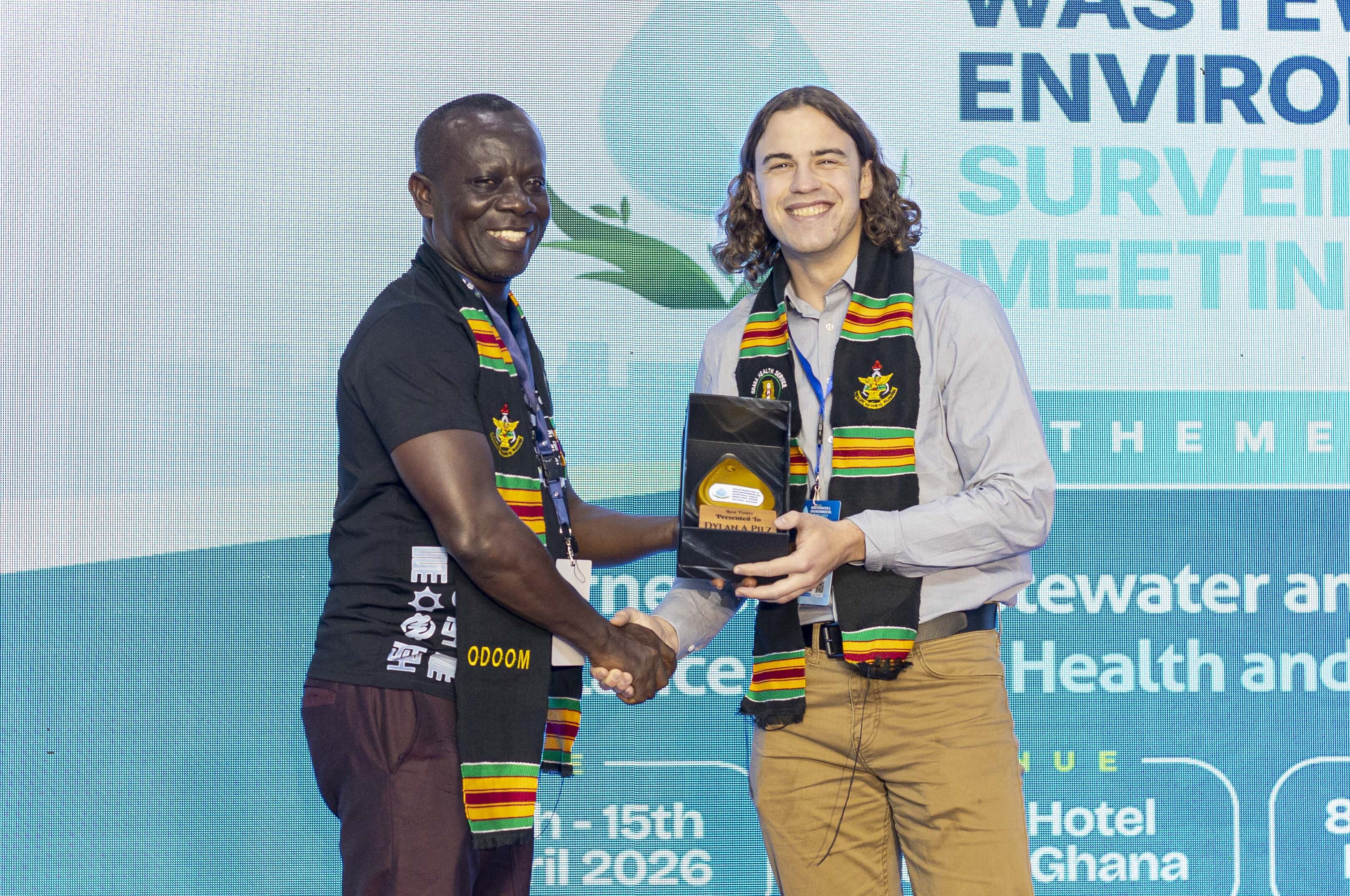
Pilz, a research programmer in the Andersen Lab at Scripps Research, took top honours for his presentation on the rapid detection of ‘cryptic’ SARS-CoV-2 variants – so called because they had previously been undetected – in wastewater in South Africa. In his presentation, he outlined a framework for detecting emerging virus diversity by integrating bioinformatic analysis into longitudinal wastewater surveillance systems.
The work is based on approaches first developed by Scripps Research in San Diego, and then tested with South Africa’s National Institute of Communicable Diseases (NICD). The NICD is responsbile for coordinating wastewater genomic surveillance across South Africa. “I share the award equally with the NICD’s incredible team, who I worked closely with on this project, and whose wet-lab and surveillance implementation expertise made computational analyses like these possible in the first place,” Pilz says.
Over the two days, he recalls, delegates enjoyed a packed programme. Pilz could hang out with the talented team at the NICD. He learned of the establishment of a cholera surveillance network in low-resource urban environments. And finally, he also helped facilitate a bioinformatics workshop that seeks to build the computational expertise required to analyse WES data at scale.
On top of this, the conference’s opening ceremony was spectacular in its own right, Pilz says. “I think that every conference should kick off with live music performed by a local band.”